
Aesthetics, Hyper-individualism, and what's next in the trend world
We’re moving from the question “What’s your aesthetic?” to the much more grounding “What do you care about?”

There’s a specific kind of fatigue that settles in your bones when you hear a word too many times in the wrong way. Aesthetic is that word for me (Riley). Once a term we used sparingly in studio critiques—about form, tone, affect—it’s now a catch‑all adjectnoun for everything from a nail color to a life philosophy. “What’s your aesthetic?” is less a question of sensibility than a prompt to produce a brand.
We’re not above it. We’re here on our blog, living our Carrie Bradshaw minute, thinking out loud while we learn how to build a house that is unabashedly based on aesthetically pleasing things. That’s the tension: loving beauty while being suspicious of the content economy.


the linguistic drift of aesthetic is a jumping-off point to a current cultural shift. Hyper‑individualism—being the most unique, the most “you,” the most distinctive feed in the room—has become the dominant aesthetic. And it’s getting old. Not because uniqueness is bad, but because the performance of uniqueness has become exhausting, homogenizing, and, ironically, boring.
How “Aesthetic” Became a Cultural Buzzword
A. Artistic to algorithmic.
In the studio, aesthetic was a scalpel. We used it to parse, narrative, moods, emotions, context. Online, it became a megaphone. Instead of describing the craft of an object or image, it now brands entire personalities: cottagecore, clean girl, alt, “insert-girl-here.” The word stopped asking how is this made? and started asking who does this make me look like?
B. Social media’s role.
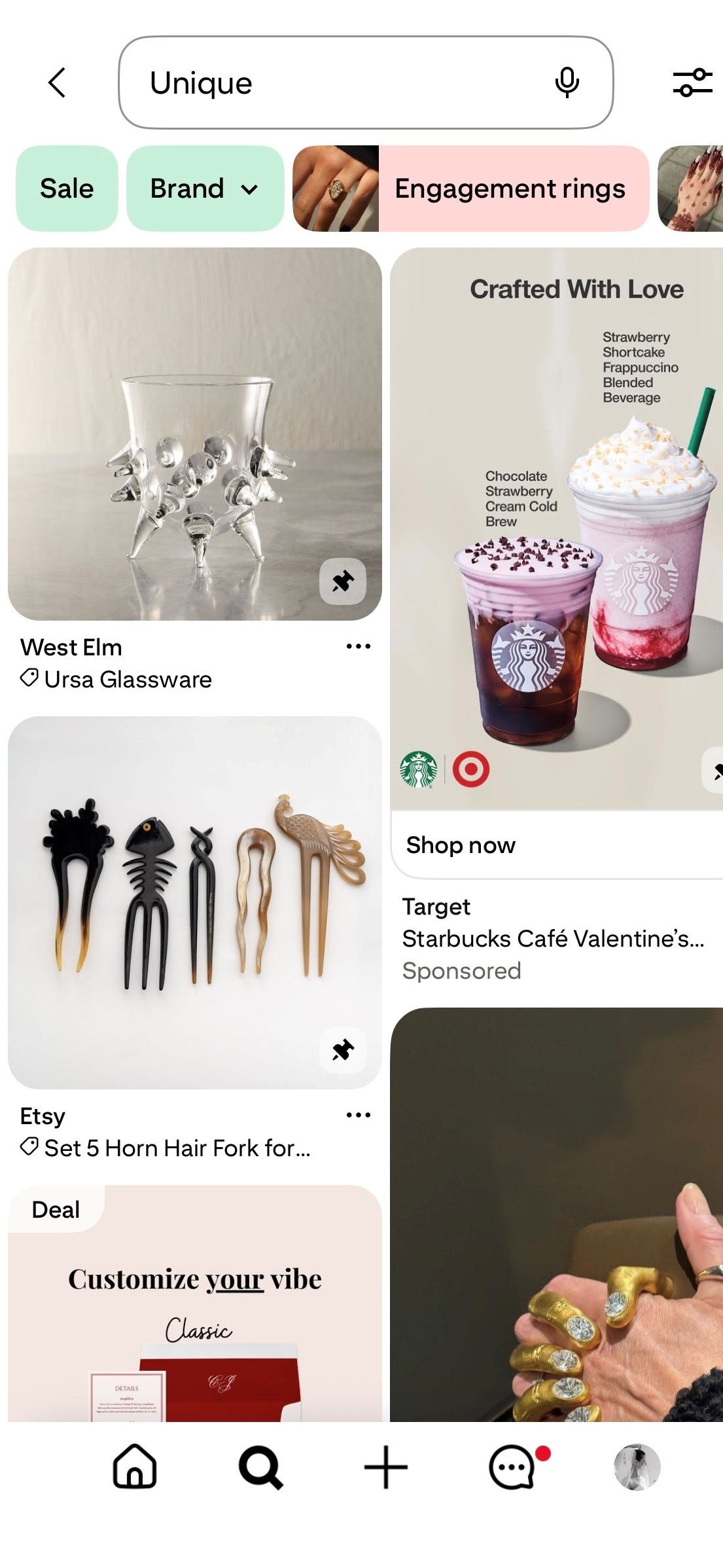
“What’s your aesthetic?” is a way to convert identity into a consumer product. Aesthetic labels become filters for shopping carts and mood boards, and because trend cycles now move at light speed, the hunt for the next micro‑aesthetic never stops. Now, you can’t even get on Pinterest without getting discreet ads peppered in with your inspo. We refresh, rebrand, repeat.


The Rise of Hyper‑Individualism as the Modern “Aesthetic”
Individualism and visual uniqueness are now seen as the same thing. We curate our clothes, interiors, playlists, hobbies—every tile and texture—for maximum distinction. We call it “authenticity,” but often it’s optimization: how do I look like me in a way you’ll recognize and reward? Vintage resurfaces every decade, as it always has, but now it arrives with a self‑conscious caption. Owning a 90s jacket isn’t inherently unique, it isn’t automatically sustainable, and it isn’t morally superior; it just means you like the jacket. The act of liking something used to be enough. Now it’s evidence to be staged.
The Irony: curated uniqueness becomes uniform.
When everyone tries to be unique in the same ways, “originality” turns predictable. The indie brand that built an ethos around scarcity and craft pivots under demand: quality slips, drops become frantic, and the mental game becomes securing a “special” thing everyone knows about. We mistake the drama of acquisition for meaning. The performance overwhelms the person.


Why Hyper‑Individualism Is Losing Its Shine
A. Emotional burnout.
We’re tired. Constant self‑branding turns people into projects with no off switch. The feed never ends; neither does the pressure to repackage experience as content. What many of us want now is unperformed life—quiet dinners, clothes that feel like us without requiring a “haul,” homes that function for living more than for the grid.
B. Cultural shift toward community and collectivity.
After the pandemic, belonging started to matter more than distinctiveness for its own sake. We’re seeing a gravitational pull toward shared values, mutual care, and cooperative making. Trends like “quiet luxury,” “bland minimalism,” and “normcore 2.0” (all, hilariously, new aesthetic labels) are symptoms of a deeper craving: less spectacle, more sanity. Fewer identity costumes; more continuity.
C. The sameness paradox.
The more we chase micro‑identities, the less individuated we feel. Trend churn squeezes every look into a template, and what’s marketed as liberated choice starts to feel like a menu where we’re all ordering the same three things. Hyper‑individualism promised freedom; it delivered a dress code.
What’s Emerging Instead
We’re moving from the question “What’s your aesthetic?” to the much more grounding “What do you care about?” This shift isn’t anti‑style; it’s pro‑substance. People are increasingly shaping their identities around values—comfort, craft, sustainability, community—letting style follow naturally rather than forcing it. You can wear a flamboyant coat or a plain white tee; the point isn’t the visual punch but whether the choice supports the life you’re actually living. This value‑driven approach creates a kind of identity that doesn’t need constant reinforcement, constant novelty, or constant branding.
At the same time, collective creativity is beginning to replace the myth of the lone genius. Collaboration is becoming more compelling than competition, and influence is expanding through connection rather than isolation. Studios, collectives, neighborhood workshops, and shared creative spaces are replacing the narrative that one person alone must build their own unshakable “aesthetic universe.” Creativity doesn’t shrink when it’s shared—it multiplies. If your look, home, or brand can only survive as a fortress protecting “your thing,” then it’s probably more fragile than you think.
Function is also overtaking spectacle as a cultural priority. Design that simply works is having a renaissance. Take Nina Pool (@ninaghoulina) for example. By being selective in the product she pushes on her platforms, she has built trust- not because the products she discusses are glamorous, in the most unique packaging, or sold at a premium. In fact, they are dollar store products, in stock packaging, sold as the lowest possible price. But the work.


Clothes that move with you, rooms that forgive clutter and naturally invite conversation, and objects that age well are becoming the new markers of taste. Beauty is returning as a byproduct of use rather than a prerequisite for likes. When style serves daily life instead of requiring life to serve style, everything becomes more grounded—and ironically, more beautiful.
How to Kill the Rut (Without Killing Your Joy)
This is where we trade the soapbox for the toolbox. If hyper‑individualism feels like a treadmill, the solution is to step off and shift into intentional living. Intentional shopping and dressing is a powerful place to start:
Limiting monthly purchases creates natural boundaries that spark creativity, while rotating items into seasonal storage can make your wardrobe feel new without introducing more things.
Touching items before buying—whether in a brick‑and‑mortar store or by borrowing it from a friend for a trial run—helps filter out pieces that don’t actually fit your life.
Choosing based on criteria like comfort, durability, and care needs anchors your decisions in reality rather than hype.
Adopting a long‑arc mindset—asking whether you’ll wear something thirty times or still love it next year—naturally cuts down on impulse accumulation.
Conclusion
If aesthetic once named the thoughtful interplay of choices, its modern overuse has blurred the term into noise—and that semantic blur reflects a broader cultural fatigue. Hyper‑individualism has asked us to be endlessly distinct, visibly and purchase‑ably so. It promised liberation but often delivered sameness, burnout, and closets full of almosts. What’s “in” now isn’t the next micro‑trend but a quiet reorientation: from performance to presence, from branding to belonging, from spectacle to substance.
We’re still building a life around beautiful things—always will. But beauty isn’t a justification or a product category. It’s a practice. It’s how we care for our spaces, our clothes, and each other. And maybe uniqueness isn’t about standing out at all; maybe it’s about standing with—and letting that be enough.
“who does this make me feel like” .. so so true. Wonderful insights sista
LOVE THIS ONE!!!